Cisco IE-3100-8T2C-E Industrial Ethernet Switch – Rugged, Secure, and Scalable Networking for Harsh Environments
Introduction
The Cisco IE-3100-8T2C-E is a ruggedized industrial Ethernet switch from the Cisco Industrial Ethernet 3100 Series, purpose-built for environments where traditional enterprise switches simply cannot survive. Unlike standard office or data center switches, the IE-3100-8T2C-E is engineered to operate reliably in harsh, mission-critical, and industrial conditions, including factories, transportation systems, utilities, oil and gas facilities, outdoor cabinets, and smart city infrastructure.
As industries increasingly adopt Industry 4.0, Industrial IoT (IIoT), smart manufacturing, edge computing, and real-time automation, the network is no longer just a supporting component — it becomes a core operational asset. Downtime, packet loss, or security breaches in industrial networks can directly translate into production halts, safety incidents, or regulatory violations. The Cisco IE-3100-8T2C-E is designed specifically to address these risks.
This switch combines:
Industrial-grade rugged hardware design
Enterprise-class Layer 2 and Layer 3 networking
Advanced security and segmentation
Long lifecycle and high availability
Seamless integration with Cisco’s enterprise and industrial ecosystem
In this guide, we explore the Cisco IE-3100-8T2C-E in extreme detail, covering hardware design, port architecture, industrial certifications, networking capabilities, redundancy, security, power systems, deployment scenarios, lifecycle value, and why it remains one of the most reliable industrial switches available today.
Cisco IE-3100-8T2C-E Overview
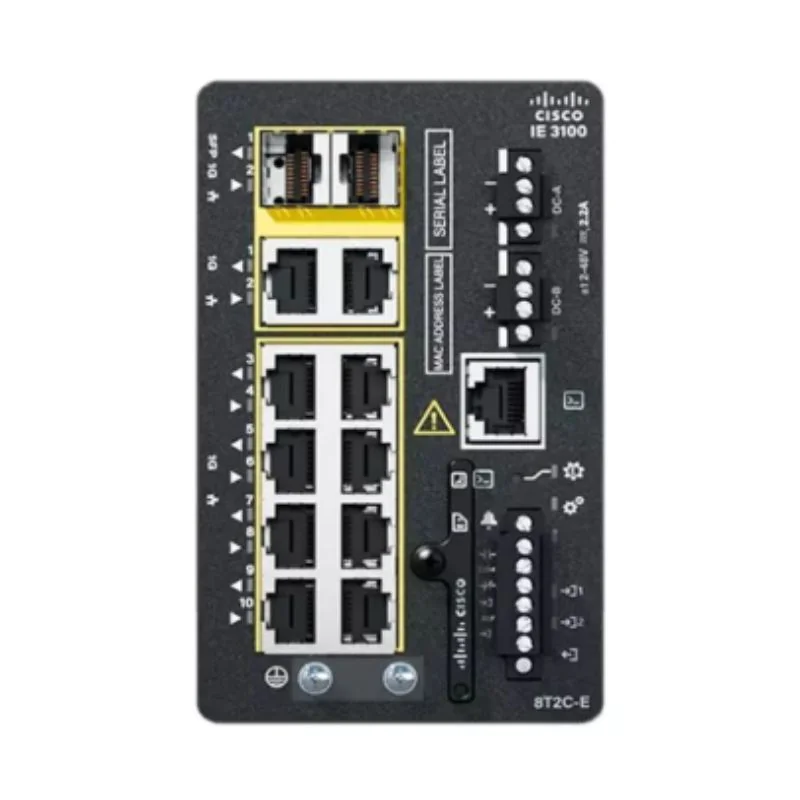
The IE-3100-8T2C-E is a compact industrial Ethernet switch that provides a balanced combination of copper connectivity, uplink flexibility, and industrial resilience.
At a high level, it offers:
8 x 10/100/1000 Ethernet copper ports (RJ-45)
2 x combo uplink ports (RJ-45 / SFP)
Fanless, ruggedized metal enclosure
Wide operating temperature range
Support for industrial power inputs
DIN-rail and panel mounting options
Enterprise-grade Cisco IOS XE software
This makes it ideal for industrial edge deployments, where space is limited, environmental conditions are unpredictable, and reliability is mandatory.
Industrial-Grade Hardware Design
Built for Harsh Environments
Unlike conventional switches designed for climate-controlled server rooms, the Cisco IE-3100-8T2C-E is engineered to operate in environments exposed to:
Extreme temperatures
Dust and airborne contaminants
Electrical noise and vibration
Power fluctuations
Physical shock and mechanical stress
The switch features a ruggedized metal chassis that protects internal components while also acting as a passive heat sink. The fanless design eliminates moving parts, which are often the first components to fail in industrial conditions.
Wide Operating Temperature Range
The IE-3100-8T2C-E supports a wide operating temperature range, allowing deployment in:
Outdoor roadside cabinets
Factory floors without air conditioning
Utility substations
Transportation infrastructure
Remote industrial sites
This temperature tolerance ensures stable operation even when environmental conditions fluctuate dramatically between day and night or across seasons.
Port Configuration and Connectivity
8 Gigabit Ethernet Copper Ports
The switch includes 8 Gigabit Ethernet RJ-45 ports, designed to connect industrial devices such as:
Programmable Logic Controllers (PLCs)
Human-Machine Interfaces (HMIs)
Industrial sensors and actuators
IP cameras and surveillance systems
Industrial wireless access points
Edge computing gateways
These ports support auto-negotiation and full-duplex communication, ensuring compatibility with a wide range of legacy and modern industrial equipment.
2 Combo Uplink Ports
The 2 combo ports provide flexibility by supporting either:
RJ-45 copper connections, or
SFP fiber transceivers
This allows the switch to act as an industrial access or aggregation node, connecting edge devices locally while uplinking to:
Core industrial switches
Enterprise campus networks
Data centers
Control rooms
SCADA systems
Fiber uplinks are particularly valuable in industrial environments because they offer immunity to electromagnetic interference (EMI), extended transmission distances, and enhanced security.
Layer 2 and Layer 3 Networking Capabilities
Advanced Layer 2 Features
At Layer 2, the Cisco IE-3100-8T2C-E supports enterprise-class switching features that are critical in industrial networks:
VLAN segmentation to isolate production zones
IEEE 802.1Q VLAN tagging
Rapid Spanning Tree Protocol (RSTP) and MSTP
Link aggregation for redundancy and bandwidth
Quality of Service (QoS) for traffic prioritization
These capabilities ensure that real-time industrial traffic — such as control signals and video streams — is not disrupted by less critical data.
Layer 3 Routing Intelligence
The IE-3100-8T2C-E also supports Layer 3 features, enabling it to perform routing functions closer to the industrial edge:
Static routing and dynamic routing protocols
Inter-VLAN routing
Policy-based traffic forwarding
Segmentation between operational technology (OT) and IT networks
This reduces dependency on centralized routers, lowers latency, and improves resilience in distributed industrial architectures.
Industrial Network Security
Defense-in-Depth Approach
Security in industrial networks is fundamentally different from office IT environments. Threats can originate from:
Unauthorized devices
Misconfigured equipment
Insider access
External cyber attacks targeting OT systems
The Cisco IE-3100-8T2C-E implements a multi-layered security architecture, including:
802.1X port-based authentication
Access Control Lists (ACLs)
MAC address filtering
Secure management access
Role-based administration
Network Segmentation and Isolation
By using VLANs and routing policies, the switch helps isolate:
Production networks
Safety systems
Surveillance systems
Corporate IT traffic
This segmentation reduces the blast radius of any incident and supports compliance with industrial cybersecurity standards.
Redundancy and High Availability
Industrial networks often support 24/7 operations, where downtime is unacceptable. The IE-3100-8T2C-E supports multiple high-availability mechanisms:
Rapid convergence protocols
Redundant uplink paths
Fast failover during link or device failure
Ring topologies for industrial Ethernet networks
These features ensure that communication continues even when individual links or devices fail.
Power Design for Industrial Environments
The switch supports industrial power inputs, allowing it to operate from power sources commonly found in factories and infrastructure sites. This flexibility ensures compatibility with existing power systems and improves reliability during voltage fluctuations.
Power protection features help safeguard the switch against surges and irregular power conditions, which are common in industrial environments.
Management and Monitoring
Cisco IOS XE Software
The IE-3100-8T2C-E runs Cisco IOS XE, providing consistency with Cisco enterprise networking platforms. This allows IT and OT teams to use familiar tools and workflows.
Monitoring and Diagnostics
The switch supports:
Real-time port status monitoring
Traffic analysis
Error detection and logging
Remote troubleshooting
These capabilities reduce mean time to repair (MTTR) and help maintain operational continuity.
Installation and Deployment Flexibility
The compact form factor allows deployment in space-constrained environments, while support for DIN-rail and panel mounting simplifies installation in control cabinets and industrial enclosures.
Fanless operation reduces maintenance requirements, making the switch ideal for remote or hard-to-access locations.
Real-World Deployment Scenarios
Manufacturing and Automation
Connects PLCs, HMIs, and robots
Supports deterministic traffic for control systems
Enables secure segmentation between production lines
Transportation and Infrastructure
Railway signaling and monitoring
Traffic management systems
Roadside surveillance and sensors
Utilities and Energy
Substations and power distribution
Renewable energy sites
Remote monitoring systems
Smart Cities and Surveillance
IP cameras and analytics
Environmental sensors
Edge computing nodes
Lifecycle and Long-Term Value
Cisco industrial switches are designed for long service lifecycles, often exceeding 10 years in the field. The IE-3100-8T2C-E benefits from:
Long-term software support
Security updates
Hardware reliability
Backward compatibility with industrial standards
This makes it a safe long-term investment for industrial and critical infrastructure projects.
Why Choose Cisco IE-3100-8T2C-E
In summary, the Cisco IE-3100-8T2C-E delivers:
Rugged industrial reliability
Enterprise-grade networking intelligence
Advanced security for OT environments
Flexible deployment options
Long lifecycle and strong ROI
It is not just a switch — it is a foundation for industrial digital transformation.
Deeper Dive: Why Industrial Ethernet Is Fundamentally Different
Traditional enterprise Ethernet switches are designed around an assumption: clean power, stable temperature, minimal vibration, predictable cabling, and IT-managed environments. Industrial Ethernet completely breaks those assumptions.
In industrial settings, networking hardware must coexist with:
High-voltage machinery
Motors generating electromagnetic interference
Dust, oil mist, moisture, and corrosive atmospheres
Mechanical vibration from moving equipment
Non-stop operational cycles with zero tolerance for downtime
The Cisco IE-3100-8T2C-E exists precisely because office-grade switches fail prematurely under these conditions. This is not a theoretical concern. In factories, substations, and transportation systems, a failed switch does not merely cause “network downtime” — it can halt production lines, disrupt safety systems, or break regulatory compliance.
Cisco engineered the IE-3100 platform to behave more like industrial control equipment than consumer IT hardware.
Fanless Architecture: Why It Matters More Than You Think
A fan is one of the weakest components in any electronic system. In industrial environments:
Dust clogs fan bearings
Oil vapor coats fan blades
Temperature cycling accelerates wear
Vibration loosens mechanical parts
By using a fanless thermal design, the IE-3100-8T2C-E eliminates an entire class of mechanical failure. Heat dissipation occurs through:
Thick metal chassis construction
Internal heat spreading
Convection-based airflow
This dramatically increases Mean Time Between Failures (MTBF) and reduces the need for on-site maintenance visits, which are often costly and slow in industrial locations.
Port-Level Reliability and Determinism
Deterministic Traffic in Industrial Networks
Unlike office networks where occasional packet delay is acceptable, industrial systems often rely on deterministic communication. Control signals must arrive within defined time windows. Even milliseconds of delay can cause:
Robotic arm misalignment
PLC cycle interruption
Sensor misreads
Safety system faults
The IE-3100-8T2C-E uses hardware-assisted forwarding and strict QoS enforcement to ensure that critical control traffic is prioritized above everything else. This is especially important when:
Video surveillance shares the same network as control systems
IT traffic converges with OT traffic
Remote monitoring traffic spikes unexpectedly
Combo Ports: Strategic Flexibility at the Industrial Edge
The inclusion of 2 combo uplink ports might seem minor on paper, but in real-world deployments, it provides enormous architectural flexibility.
Copper Uplinks
Used when:
Distance is short
EMI is manageable
Existing copper cabling is already deployed
Fiber Uplinks
Preferred when:
Long distances are involved
High EMI environments exist
Electrical isolation is required
Security policies demand fiber-only backhaul
This dual-mode capability allows integrators to adapt without changing hardware, reducing spare parts inventory and simplifying design standardization across sites.
Layer 3 at the Edge: Reducing Blast Radius
Placing Layer 3 routing directly on the IE-3100-8T2C-E enables network segmentation at the edge, which is a massive security and stability advantage.
Instead of funneling all traffic back to a central router:
Local traffic stays local
Broadcast domains are reduced
Faults are contained
Latency is minimized
In industrial cybersecurity, this directly supports zones and conduits architecture recommended by standards such as IEC 62443.
Security: OT Reality vs IT Theory
Industrial security failures are often not caused by advanced hackers — they’re caused by:
Unintentional misconfiguration
Unauthorized devices plugged into ports
Flat networks with no segmentation
Legacy equipment with zero security awareness
The IE-3100-8T2C-E addresses this reality through practical, enforceable controls, not just theoretical security features.
Port-Level Control
Each Ethernet port can be treated as a controlled access point:
Authenticate devices
Restrict MAC addresses
Enforce VLAN assignment
Apply ACLs at ingress
Secure Management Plane
Administrative access can be tightly controlled, ensuring:
Only authorized engineers can modify configurations
All changes are auditable
Remote management does not expose attack surfaces
This is essential in regulated industries where compliance audits are routine.
Industrial Power Reality: Why Flexibility Saves Projects
Industrial sites rarely have “clean” power. Voltage fluctuations, brownouts, and transient spikes are common. The IE-3100-8T2C-E is designed to tolerate these realities without crashing, corrupting configuration, or requiring manual resets.
This stability is critical in:
Remote substations
Outdoor cabinets
Renewable energy installations
Transportation infrastructure
A switch rebooting unexpectedly can cascade into system-wide faults.
Deployment Psychology: Why Engineers Trust IE-3100
System integrators and OT engineers tend to reuse platforms that have proven field reliability. The IE-3100 series has been deployed globally in:
Automotive manufacturing plants
Semiconductor fabs
Oil and gas facilities
Rail signaling systems
Power distribution networks
This matters because engineers design around predictability. When a switch behaves consistently across deployments, it becomes a trusted building block rather than a risk factor.
Combo Ports: Strategic Flexibility at the Industrial Edge
The inclusion of 2 combo uplink ports might seem minor on paper, but in real-world deployments, it provides enormous architectural flexibility.
Copper Uplinks
Used when:
Distance is short
EMI is manageable
Existing copper cabling is already deployed
Fiber Uplinks
Preferred when:
Long distances are involved
High EMI environments exist
Electrical isolation is required
Security policies demand fiber-only backhaul
This dual-mode capability allows integrators to adapt without changing hardware, reducing spare parts inventory and simplifying design standardization across sites.
Layer 3 at the Edge: Reducing Blast Radius
Placing Layer 3 routing directly on the IE-3100-8T2C-E enables network segmentation at the edge, which is a massive security and stability advantage.
Instead of funneling all traffic back to a central router:
Local traffic stays local
Broadcast domains are reduced
Faults are contained
Latency is minimized
In industrial cybersecurity, this directly supports zones and conduits architecture recommended by standards such as IEC 62443.
Security: OT Reality vs IT Theory
Industrial security failures are often not caused by advanced hackers — they’re caused by:
Unintentional misconfiguration
Unauthorized devices plugged into ports
Flat networks with no segmentation
Legacy equipment with zero security awareness
The IE-3100-8T2C-E addresses this reality through practical, enforceable controls, not just theoretical security features.
Port-Level Control
Each Ethernet port can be treated as a controlled access point:
Authenticate devices
Restrict MAC addresses
Enforce VLAN assignment
Apply ACLs at ingress
Secure Management Plane
Administrative access can be tightly controlled, ensuring:
Only authorized engineers can modify configurations
All changes are auditable
Remote management does not expose attack surfaces
This is essential in regulated industries where compliance audits are routine.
Industrial Power Reality: Why Flexibility Saves Projects
Industrial sites rarely have “clean” power. Voltage fluctuations, brownouts, and transient spikes are common. The IE-3100-8T2C-E is designed to tolerate these realities without crashing, corrupting configuration, or requiring manual resets.
This stability is critical in:
Remote substations
Outdoor cabinets
Renewable energy installations
Transportation infrastructure
A switch rebooting unexpectedly can cascade into system-wide faults.
Deployment Psychology: Why Engineers Trust IE-3100
System integrators and OT engineers tend to reuse platforms that have proven field reliability. The IE-3100 series has been deployed globally in:
Automotive manufacturing plants
Semiconductor fabs
Oil and gas facilities
Rail signaling systems
Power distribution networks
This matters because engineers design around predictability. When a switch behaves consistently across deployments, it becomes a trusted building block rather than a risk factor.
Lifecycle Longevity: Industrial Timeframes Are Different
Enterprise IT hardware often has a lifecycle of 3–5 years. Industrial systems operate on 10–20 year timelines. Replacing network hardware is expensive not because of the device cost, but because of:
Downtime planning
Validation and testing
Regulatory approvals
Physical access constraints
The Cisco IE-3100-8T2C-E is built with this reality in mind:
Long-term software support
Stable hardware design
Backward compatibility
Consistent command-line behavior
This dramatically reduces long-term operational risk.
Why the IE-3100-8T2C-E Is an “Edge Backbone”
Although compact, the IE-3100-8T2C-E often becomes the local backbone of an industrial zone. It aggregates devices, enforces policy, routes traffic, and uplinks to higher layers — all while surviving conditions that would destroy ordinary switches.
In that sense, it is not just an access switch. It is a resilient, intelligent edge platform.
Final Perspective
If enterprise switches are designed for comfort, the Cisco IE-3100-8T2C-E is designed for survival.
If office networks prioritize convenience, industrial networks prioritize certainty.
If IT accepts occasional downtime, OT cannot.
This switch exists because failure is not an option.

🛒 Get It From Choicecycle (SGCCTV Singapore)
For authentic Cisco industrial networking hardware, expert consultation, and competitive pricing, purchase the Cisco IE-3100-8T2C-E Industrial Ethernet Switch from Choicecycle (SGCCTV Singapore).
🌐 Website: https://sgcctv.com.sg
✉️ Email: enquiry@choicecycle.com.sg
📞 WhatsApp: +65 9853 4404
📍 Store Location: Sim Lim Square #02-81, Singapore
🕚 Operating Hours: 11 AM – 8 PM
Choicecycle (SGCCTV Singapore) is your trusted supplier for Cisco Industrial Ethernet switches, enterprise networking equipment, and mission-critical infrastructure solutions.


Nunc lacus elit, faucibus ac laoreet sed, dapibus ac mi. Maecenas eu ante a elit tempus fermentum. Aliquam commodo tincidunt semper. Phasellus accumsan, justo ac mollis pharetra, ex dui pharetra nisl, a scelerisque ipsum nulla ac sem. Cras eu risus urna. Duis lorem sapien, congue eget nisl sit amet, rutrum faucibus elit.
Donec accumsan auctor iaculis. Sed suscipit arcu ligula, at egestas magna molestie a. Proin ac ex maximus, ultrices justo eget, sodales orci. Aliquam egestas libero ac turpis pharetra, in vehicula lacus scelerisque. Vestibulum ut sem laoreet, feugiat tellus at, hendrerit arcu.
Nunc lacus elit, faucibus ac laoreet sed, dapibus ac mi. Maecenas eu ante a elit tempus fermentum. Aliquam commodo tincidunt semper. Phasellus accumsan, justo ac mollis pharetra, ex dui pharetra nisl, a scelerisque ipsum nulla ac sem. Cras eu risus urna. Duis lorem sapien, congue eget nisl sit amet, rutrum faucibus elit.