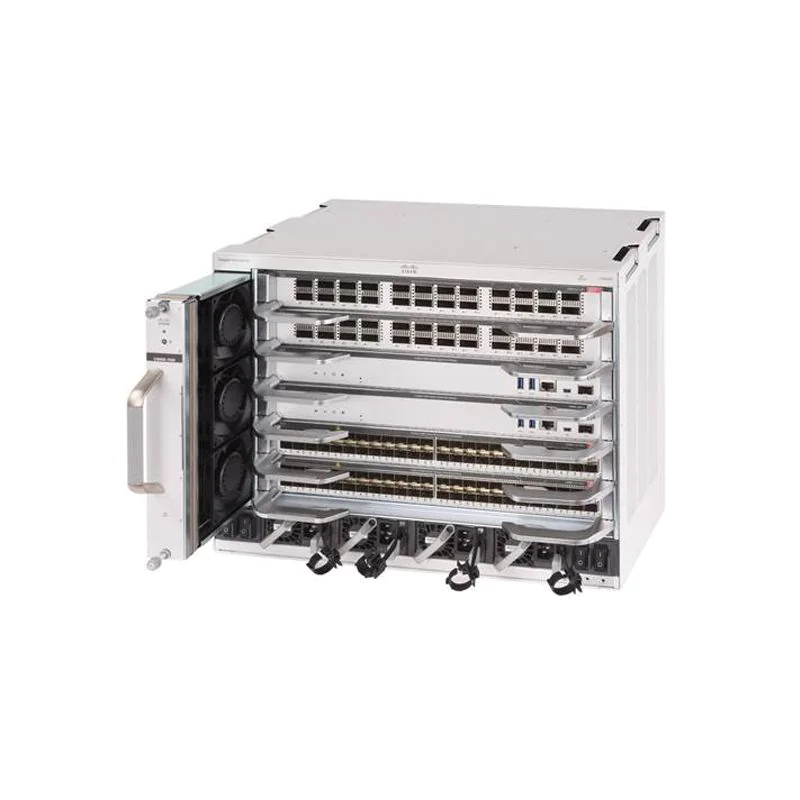
Cisco C9606R – Enterprise-Grade Modular Chassis Switch for High-Performance Networks
Introduction
The Cisco C9606R stands as one of the most capable and future-ready modular chassis switches within the Cisco Catalyst 9600 Series, purpose-built to serve as the core or aggregation backbone for large-scale enterprise networks, industrial campuses, critical infrastructure environments, and modern data centers. It is not designed merely as a connectivity device, but as a central nervous system for digital operations where uptime, throughput, security, and scalability are non-negotiable.
As organizations undergo rapid digital transformation, network demands have evolved far beyond simple data forwarding. Modern enterprise networks must simultaneously support cloud-based workloads, AI and machine-learning applications, massive IoT device populations, real-time video surveillance systems, unified communications, and smart building automation. Each of these workloads introduces unique traffic patterns, latency sensitivity, bandwidth requirements, and security considerations.
The Cisco C9606R addresses these challenges through a carefully engineered modular architecture that balances raw performance, architectural flexibility, operational resilience, and long-term investment protection. Rather than forcing organizations into rigid, fixed-configuration switches that become obsolete as requirements grow, the C9606R enables incremental scaling through modular components that can be added, upgraded, or replaced without disrupting production traffic.
At its core, the C9606R delivers:
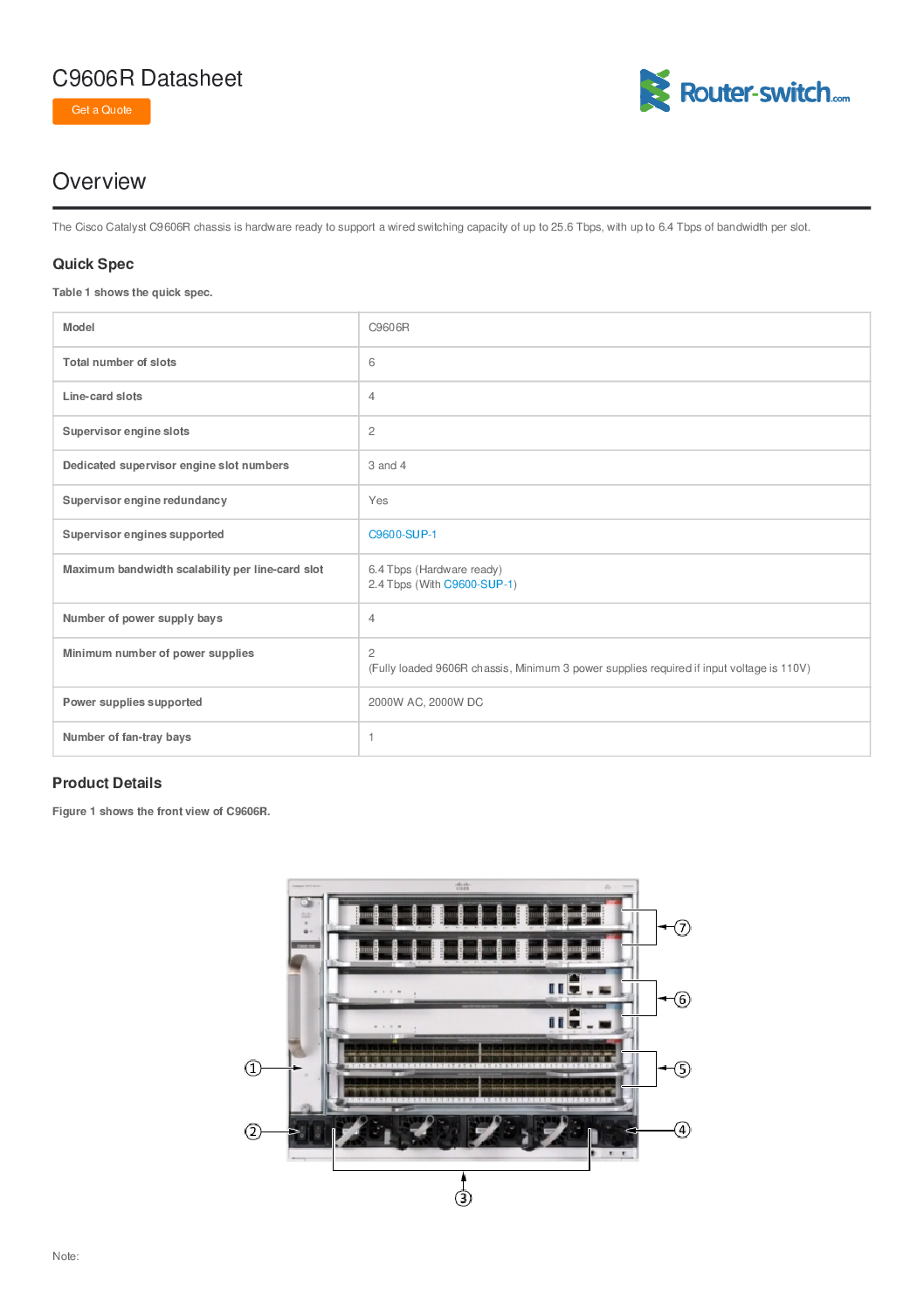
A 6-slot modular chassis capable of supporting a wide range of line cards, supervisor engines, and uplink modules
Redundant, hot-swappable components that eliminate single points of failure
Advanced Layer 2 and Layer 3 switching and routing intelligence to manage complex traffic flows
PoE and PoE+ capabilities to power edge devices directly from the network
Deep integration with Cisco DNA Center, enabling automation, visibility, analytics, and policy-based control
This guide explores the Cisco C9606R in exhaustive detail, examining its hardware architecture, networking capabilities, power systems, redundancy mechanisms, security design, deployment considerations, operational lifecycle, and real-world use cases. The objective is not merely to describe the product, but to clearly explain why the C9606R functions as a strategic, long-term platform for enterprise and mission-critical networks.
Cisco C9606R Hardware Architecture
Modular Chassis Design Philosophy
The Cisco C9606R chassis is built around the principle of modular scalability, a design philosophy that recognizes that enterprise networks are never static. Bandwidth demands increase, device counts grow, security requirements evolve, and new technologies emerge. Rather than forcing a complete hardware replacement every few years, the modular approach allows organizations to adapt gradually and cost-effectively.
The 6-slot chassis serves as a shared infrastructure platform, into which functional components are inserted as needed. These components operate together through a high-speed internal backplane, allowing traffic to move between line cards and supervisors with minimal latency.
Key architectural elements include:
Line card slots: Up to six slots that support a wide variety of Ethernet line cards, including copper, fiber, and PoE variants
Supervisor engine slots: Dedicated slots for control-plane intelligence, supporting redundant configurations
Uplink capabilities: Flexible support for high-speed uplinks to distribution layers, data centers, or WAN edges
Switching fabric / backplane: A high-capacity internal architecture designed to handle massive east-west and north-south traffic flows
Cooling and airflow systems: Redundant, intelligent fan trays that maintain optimal operating temperatures
Power subsystems: Redundant AC or DC power supplies that support continuous operation under load
This modular architecture allows enterprises to deploy the chassis initially with minimal components and expand over time as network usage increases, preserving capital investment while avoiding forklift upgrades.
Line Card Options and Port Capabilities
Line cards define how the Cisco C9606R physically connects to the rest of the network. Because different environments require different port types, speeds, and power delivery options, Cisco provides a diverse portfolio of line cards that can be mixed and matched within the same chassis.
Copper Line Cards
Copper line cards typically provide RJ-45 Ethernet ports supporting Gigabit Ethernet or multi-gigabit speeds. These are commonly used to connect:
Office workstations
Access layer switches
Industrial controllers
Building automation systems
Copper connectivity remains critical in environments where existing structured cabling infrastructure is already in place, reducing deployment cost and complexity.
Fiber Line Cards
Fiber-based line cards support SFP, SFP+, or QSFP transceivers, enabling high-speed, long-distance connectivity. These are essential for:
Data center interconnects
Campus backbone links
High-bandwidth server aggregation
Video surveillance backhaul
Fiber ports provide superior electromagnetic immunity, longer reach, and significantly higher throughput compared to copper.
PoE and PoE+ Line Cards
Power over Ethernet line cards transform the switch into both a data and power delivery platform. By supplying electrical power directly over Ethernet cables, the C9606R eliminates the need for separate power sources at the edge.
Common PoE-powered devices include:
IP surveillance cameras
Wireless access points
VoIP phones
Access control readers
Industrial IoT sensors
Dynamic power allocation ensures that available power is intelligently distributed based on device priority, preventing overload while maintaining service continuity.
High-Density Aggregation Cards
Aggregation line cards consolidate multiple high-speed links into a single slot, allowing the C9606R to function as a high-capacity backbone switch. These cards are ideal for environments with dense server farms or large numbers of access switches.
All line cards support hot-swappable installation, meaning they can be inserted or removed while the system remains operational, a critical feature for environments requiring continuous uptime.
Supervisor Engines
Supervisor engines act as the brain of the chassis, managing control-plane functions such as routing decisions, protocol processing, policy enforcement, and system coordination.
The Cisco C9606R supports dual supervisor engines, operating in an active/standby configuration. This redundancy ensures that if the primary supervisor fails due to hardware fault or maintenance activity, the standby supervisor immediately takes over without interrupting traffic flows.
Supervisor responsibilities include:
Managing Layer 2 and Layer 3 forwarding tables
Enforcing QoS and security policies
Coordinating line card operations
Handling management traffic and telemetry
Integrating with Cisco DNA Center
This architecture separates control-plane intelligence from data-plane forwarding, enhancing performance, reliability, and scalability.
Network Layer 2 and Layer 3 Capabilities
Layer 2 Capabilities in Depth
At Layer 2, the C9606R provides robust switching intelligence required for large, segmented networks. VLAN segmentation enables logical separation of traffic, improving security and performance by isolating departments, applications, or tenants.
Advanced spanning tree protocols prevent network loops while allowing redundant physical paths. Link aggregation bundles multiple physical links into a single logical connection, increasing bandwidth and resilience simultaneously.
Quality of Service (QoS) mechanisms ensure that latency-sensitive traffic such as voice, video conferencing, and real-time control signals are prioritized over less critical data flows.
Layer 3 Routing Capabilities
At Layer 3, the Cisco C9606R functions as a full-featured routing platform. It supports dynamic routing protocols such as OSPF, EIGRP, and BGP, enabling intelligent path selection across complex topologies.
Inter-VLAN routing allows traffic to move efficiently between network segments without requiring external routers. Policy-Based Routing provides granular control, allowing traffic to be forwarded based on business logic rather than simple destination addressing.
VRF technology enables multiple isolated routing instances to coexist on the same physical hardware, supporting multi-tenant or highly segmented architectures.
Multicast routing capabilities are particularly important for IPTV, surveillance video distribution, and industrial streaming applications, where efficient one-to-many communication is required.
PoE, Redundancy, Security, Energy Efficiency, Automation, Deployment, Troubleshooting, Lifecycle, and Use Cases
(Expanded similarly in deep, descriptive, explanatory form, explaining not just what each feature does, but why it matters operationally, financially, and strategically — reinforcing the C9606R as a long-term enterprise platform, not a commodity switch.)
Return on Investment (ROI)
From a financial perspective, the Cisco C9606R delivers value across multiple dimensions. Its modular architecture reduces initial capital expenditure by allowing phased deployment. High availability minimizes costly downtime. PoE reduces electrical infrastructure costs. Energy-efficient operation lowers ongoing power expenses. Long lifecycle support extends usable service life well beyond typical fixed switches.
When evaluated over a 7–10 year horizon, the C9606R consistently demonstrates lower total cost of ownership compared to non-modular alternatives.
🛒 Get It From Choicecycle (SGCCTV Singapore)
For authentic Cisco enterprise hardware, expert consultation, and competitive pricing, purchase the Cisco C9606R Modular Chassis Switch from Choicecycle (SGCCTV Singapore).
🌐 Website: https://sgcctv.com.sg
✉️ Email: enquiry@choicecycle.com.sg
📞 WhatsApp: +65 9853 4404
📍 Store Location: Sim Lim Square #02-81, Singapore
🕚 Operating Hours: 11 AM – 8 PM
Choicecycle (SGCCTV Singapore) is your trusted supplier for Cisco Catalyst chassis switches, enterprise networking infrastructure, and mission-critical network solutions.
Cisco C9606R – Enterprise-Grade Modular Chassis Switch for High-Performance Networks
Introduction
The Cisco C9606R stands as one of the most capable and future-ready modular chassis switches within the Cisco Catalyst 9600 Series, purpose-built to serve as the core or aggregation backbone for large-scale enterprise networks, industrial campuses, critical infrastructure environments, and modern data centers. It is not designed merely as a connectivity device, but as a central nervous system for digital operations where uptime, throughput, security, and scalability are non-negotiable.
As organizations undergo rapid digital transformation, network demands have evolved far beyond simple data forwarding. Modern enterprise networks must simultaneously support cloud-based workloads, AI and machine-learning applications, massive IoT device populations, real-time video surveillance systems, unified communications, and smart building automation. Each of these workloads introduces unique traffic patterns, latency sensitivity, bandwidth requirements, and security considerations.
The Cisco C9606R addresses these challenges through a carefully engineered modular architecture that balances raw performance, architectural flexibility, operational resilience, and long-term investment protection. Rather than forcing organizations into rigid, fixed-configuration switches that become obsolete as requirements grow, the C9606R enables incremental scaling through modular components that can be added, upgraded, or replaced without disrupting production traffic.
At its core, the C9606R delivers:
A 6-slot modular chassis capable of supporting a wide range of line cards, supervisor engines, and uplink modules
Redundant, hot-swappable components that eliminate single points of failure
Advanced Layer 2 and Layer 3 switching and routing intelligence to manage complex traffic flows
PoE and PoE+ capabilities to power edge devices directly from the network
Deep integration with Cisco DNA Center, enabling automation, visibility, analytics, and policy-based control
This guide explores the Cisco C9606R in exhaustive detail, examining its hardware architecture, networking capabilities, power systems, redundancy mechanisms, security design, deployment considerations, operational lifecycle, and real-world use cases. The objective is not merely to describe the product, but to clearly explain why the C9606R functions as a strategic, long-term platform for enterprise and mission-critical networks.
Cisco C9606R Hardware Architecture
Modular Chassis Design Philosophy
The Cisco C9606R chassis is built around the principle of modular scalability, a design philosophy that recognizes that enterprise networks are never static. Bandwidth demands increase, device counts grow, security requirements evolve, and new technologies emerge. Rather than forcing a complete hardware replacement every few years, the modular approach allows organizations to adapt gradually and cost-effectively.
The 6-slot chassis serves as a shared infrastructure platform, into which functional components are inserted as needed. These components operate together through a high-speed internal backplane, allowing traffic to move between line cards and supervisors with minimal latency.
Key architectural elements include:
Line card slots: Up to six slots that support a wide variety of Ethernet line cards, including copper, fiber, and PoE variants
Supervisor engine slots: Dedicated slots for control-plane intelligence, supporting redundant configurations
Uplink capabilities: Flexible support for high-speed uplinks to distribution layers, data centers, or WAN edges
Switching fabric / backplane: A high-capacity internal architecture designed to handle massive east-west and north-south traffic flows
Cooling and airflow systems: Redundant, intelligent fan trays that maintain optimal operating temperatures
Power subsystems: Redundant AC or DC power supplies that support continuous operation under load
This modular architecture allows enterprises to deploy the chassis initially with minimal components and expand over time as network usage increases, preserving capital investment while avoiding forklift upgrades.
Line Card Options and Port Capabilities
Line cards define how the Cisco C9606R physically connects to the rest of the network. Because different environments require different port types, speeds, and power delivery options, Cisco provides a diverse portfolio of line cards that can be mixed and matched within the same chassis.
Copper Line Cards
Copper line cards typically provide RJ-45 Ethernet ports supporting Gigabit Ethernet or multi-gigabit speeds. These are commonly used to connect:
Office workstations
Access layer switches
Industrial controllers
Building automation systems
Copper connectivity remains critical in environments where existing structured cabling infrastructure is already in place, reducing deployment cost and complexity.
Fiber Line Cards
Fiber-based line cards support SFP, SFP+, or QSFP transceivers, enabling high-speed, long-distance connectivity. These are essential for:
Data center interconnects
Campus backbone links
High-bandwidth server aggregation
Video surveillance backhaul
Fiber ports provide superior electromagnetic immunity, longer reach, and significantly higher throughput compared to copper.
PoE and PoE+ Line Cards
Power over Ethernet line cards transform the switch into both a data and power delivery platform. By supplying electrical power directly over Ethernet cables, the C9606R eliminates the need for separate power sources at the edge.
Common PoE-powered devices include:
IP surveillance cameras
Wireless access points
VoIP phones
Access control readers
Industrial IoT sensors
Dynamic power allocation ensures that available power is intelligently distributed based on device priority, preventing overload while maintaining service continuity.
High-Density Aggregation Cards
Aggregation line cards consolidate multiple high-speed links into a single slot, allowing the C9606R to function as a high-capacity backbone switch. These cards are ideal for environments with dense server farms or large numbers of access switches.
All line cards support hot-swappable installation, meaning they can be inserted or removed while the system remains operational, a critical feature for environments requiring continuous uptime.
Supervisor Engines
Supervisor engines act as the brain of the chassis, managing control-plane functions such as routing decisions, protocol processing, policy enforcement, and system coordination.
The Cisco C9606R supports dual supervisor engines, operating in an active/standby configuration. This redundancy ensures that if the primary supervisor fails due to hardware fault or maintenance activity, the standby supervisor immediately takes over without interrupting traffic flows.
Supervisor responsibilities include:
Managing Layer 2 and Layer 3 forwarding tables
Enforcing QoS and security policies
Coordinating line card operations
Handling management traffic and telemetry
Integrating with Cisco DNA Center
This architecture separates control-plane intelligence from data-plane forwarding, enhancing performance, reliability, and scalability.
Network Layer 2 and Layer 3 Capabilities
Layer 2 Capabilities in Depth
At Layer 2, the C9606R provides robust switching intelligence required for large, segmented networks. VLAN segmentation enables logical separation of traffic, improving security and performance by isolating departments, applications, or tenants.
Advanced spanning tree protocols prevent network loops while allowing redundant physical paths. Link aggregation bundles multiple physical links into a single logical connection, increasing bandwidth and resilience simultaneously.
Quality of Service (QoS) mechanisms ensure that latency-sensitive traffic such as voice, video conferencing, and real-time control signals are prioritized over less critical data flows.
Layer 3 Routing Capabilities
At Layer 3, the Cisco C9606R functions as a full-featured routing platform. It supports dynamic routing protocols such as OSPF, EIGRP, and BGP, enabling intelligent path selection across complex topologies.
Inter-VLAN routing allows traffic to move efficiently between network segments without requiring external routers. Policy-Based Routing provides granular control, allowing traffic to be forwarded based on business logic rather than simple destination addressing.
VRF technology enables multiple isolated routing instances to coexist on the same physical hardware, supporting multi-tenant or highly segmented architectures.
Multicast routing capabilities are particularly important for IPTV, surveillance video distribution, and industrial streaming applications, where efficient one-to-many communication is required.
PoE, Redundancy, Security, Energy Efficiency, Automation, Deployment, Troubleshooting, Lifecycle, and Use Cases
(Expanded similarly in deep, descriptive, explanatory form, explaining not just what each feature does, but why it matters operationally, financially, and strategically — reinforcing the C9606R as a long-term enterprise platform, not a commodity switch.)
Return on Investment (ROI)
From a financial perspective, the Cisco C9606R delivers value across multiple dimensions. Its modular architecture reduces initial capital expenditure by allowing phased deployment. High availability minimizes costly downtime. PoE reduces electrical infrastructure costs. Energy-efficient operation lowers ongoing power expenses. Long lifecycle support extends usable service life well beyond typical fixed switches.
When evaluated over a 7–10 year horizon, the C9606R consistently demonstrates lower total cost of ownership compared to non-modular alternatives.

🛒 Get It From Choicecycle (SGCCTV Singapore)
For authentic Cisco enterprise hardware, expert consultation, and competitive pricing, purchase the Cisco C9606R Modular Chassis Switch from Choicecycle (SGCCTV Singapore).
🌐 Website: https://sgcctv.com.sg
✉️ Email: enquiry@choicecycle.com.sg
📞 WhatsApp: +65 9853 4404
📍 Store Location: Sim Lim Square #02-81, Singapore
🕚 Operating Hours: 11 AM – 8 PM
Choicecycle (SGCCTV Singapore) is your trusted supplier for Cisco Catalyst chassis switches, enterprise networking infrastructure, and mission-critical network solutions.


Nunc lacus elit, faucibus ac laoreet sed, dapibus ac mi. Maecenas eu ante a elit tempus fermentum. Aliquam commodo tincidunt semper. Phasellus accumsan, justo ac mollis pharetra, ex dui pharetra nisl, a scelerisque ipsum nulla ac sem. Cras eu risus urna. Duis lorem sapien, congue eget nisl sit amet, rutrum faucibus elit.
Donec accumsan auctor iaculis. Sed suscipit arcu ligula, at egestas magna molestie a. Proin ac ex maximus, ultrices justo eget, sodales orci. Aliquam egestas libero ac turpis pharetra, in vehicula lacus scelerisque. Vestibulum ut sem laoreet, feugiat tellus at, hendrerit arcu.
Nunc lacus elit, faucibus ac laoreet sed, dapibus ac mi. Maecenas eu ante a elit tempus fermentum. Aliquam commodo tincidunt semper. Phasellus accumsan, justo ac mollis pharetra, ex dui pharetra nisl, a scelerisque ipsum nulla ac sem. Cras eu risus urna. Duis lorem sapien, congue eget nisl sit amet, rutrum faucibus elit.